Death By Pennies
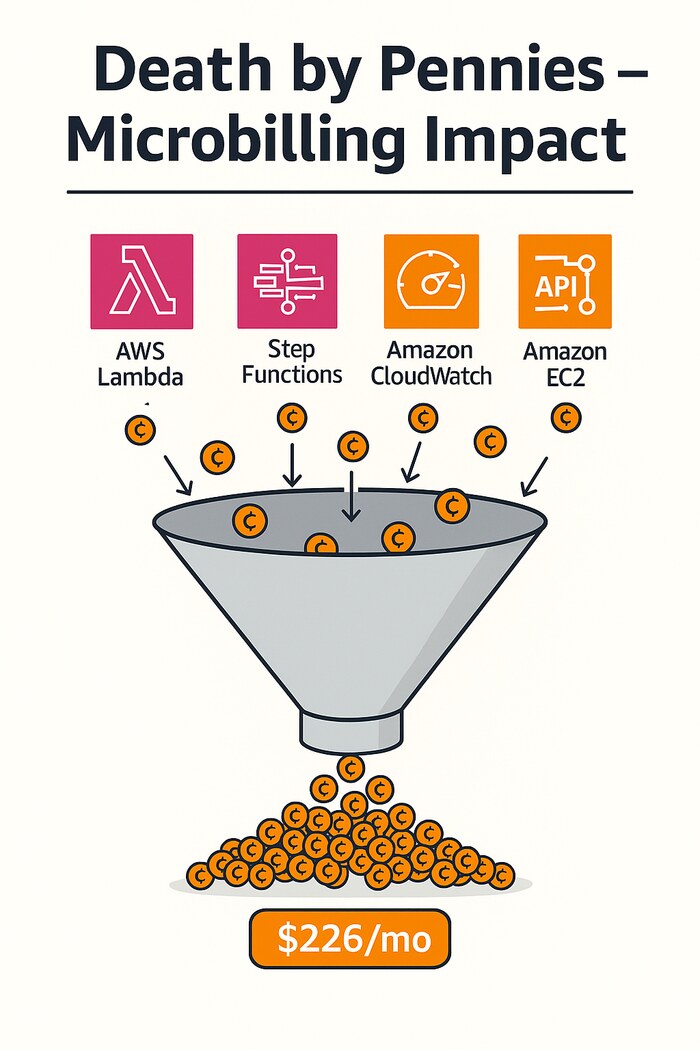
Cloud bills do not fail loudly. They bleed quietly, one penny at a time, until the ten thousand dollar contract you signed becomes a thirty thousand dollar bill that nobody can quite explain. This series is the story of those pennies, the architecture choices that mint them, and the discipline it takes to stop them.
If you are not watching the pennies, the next thing you know you have a million pennies falling on your head, and that is going to hurt worse than any single cut.

The teaser
How We Built a Cross Region Floating IP Architecture on AWS for Static IP Healthcare Systems
Most hospital floors run on devices that only know one address each, a single static IP hard coded into firmware. Move that fleet to the cloud and the first regional failover takes them down. This is how we built a cross region floating IP architecture on AWS to keep static IP clinical systems alive when the infrastructure underneath them has to move.
Read on Optimum →Other writing
Coming next
Why Healthcare Is Walking Away From Traditional VDI
A look at the cost arithmetic behind healthcare's exit from Citrix and VMware Horizon, and what the alternatives actually cost once the migration is done. In drafting.
The book
Death By Pennies
Three canonical workloads, a high transaction public site, a B2B SaaS analytics product, and an AI feature add, priced line by line across AWS, GCP, and Azure. Every penny traced from invoice back to the architecture decision that minted it. About 35,000 to 50,000 words, in drafting through 2026 and into 2027.
About
I lead healthcare cloud solutions at Optimum Healthcare IT, where I set the strategy for enterprise cloud ecosystems and mentor a community of architects across our delivery teams. My work sits at the intersection of cloud strategy, security, and the operational realities of healthcare: shared devices, mobile clinicians, endpoint churn, the identity risks that come with all of it.
Over three decades in IT, fifteen years in cloud, mostly inside healthcare since 2010. PHI, audit, residency, and uptime rules don't leave many places to cut, which is exactly why the architecture choices matter so much.
This site is where I write Death by Pennies on nights and weekends. It started as a writing project and may end up as the basis for doctoral work. Still deciding. Either way, it's the long version of a conversation I keep having: why smart teams keep signing ten thousand dollar contracts that turn into thirty thousand dollar bills, and what it takes to stop the bleed.